

History of pens is a fascinating journey that traces the evolution of writing instruments from ancient times. The beginning of writing itself was not in the form of words but more of scratches to the surface of moist clay using a bronze tool or a bone tool. From there the earliest form of documentation would be the more known depiction of what happened via pictures by the Egyptians (3000 BCE). Simultaneously for writing on papyrus scrolls, scribes used thin reed (a tall slender-leaved plant that grows in water or in marshy grounds) brushes or reed pens. In 1300 BCE, the Romans began developing a form of writing that they scribed into thin sheets of wax (on wooden tablets) using a metal stylus. When the writing was no longer needed the scribe would rub it off with the flat end of the stylus. This similar method was adopted in Asia but instead of a metal stylus they used a bronze stylus.

The anglo-saxons used tablets filled with wax for notes and for planning the layout of large books with text alongside parchment. They wrote on the tablets with a metal or bone stylus that had a pointed end and rubbed out the words with the flat end. In medieval Europe (600-1800 CE), popularity rose on quill pens, made from the feathers of large birds like geese, found that writing on a quill pen altered their style of writing. The hollow shaft of the feather held the ink and the tip was cut as a nib. These quill pens first appeared in Seville, Spain beginning with capital letters and moving on to small letters and numbers. In the 1790s the pencil lead was then invented independently in France and Australia. This form of a writing instrument was relatively better than a quill in the sense that there was no risk of ink spills and splashes but like the regular pencil it did not promote a sense of confirmation in terms of much needed and important documents.

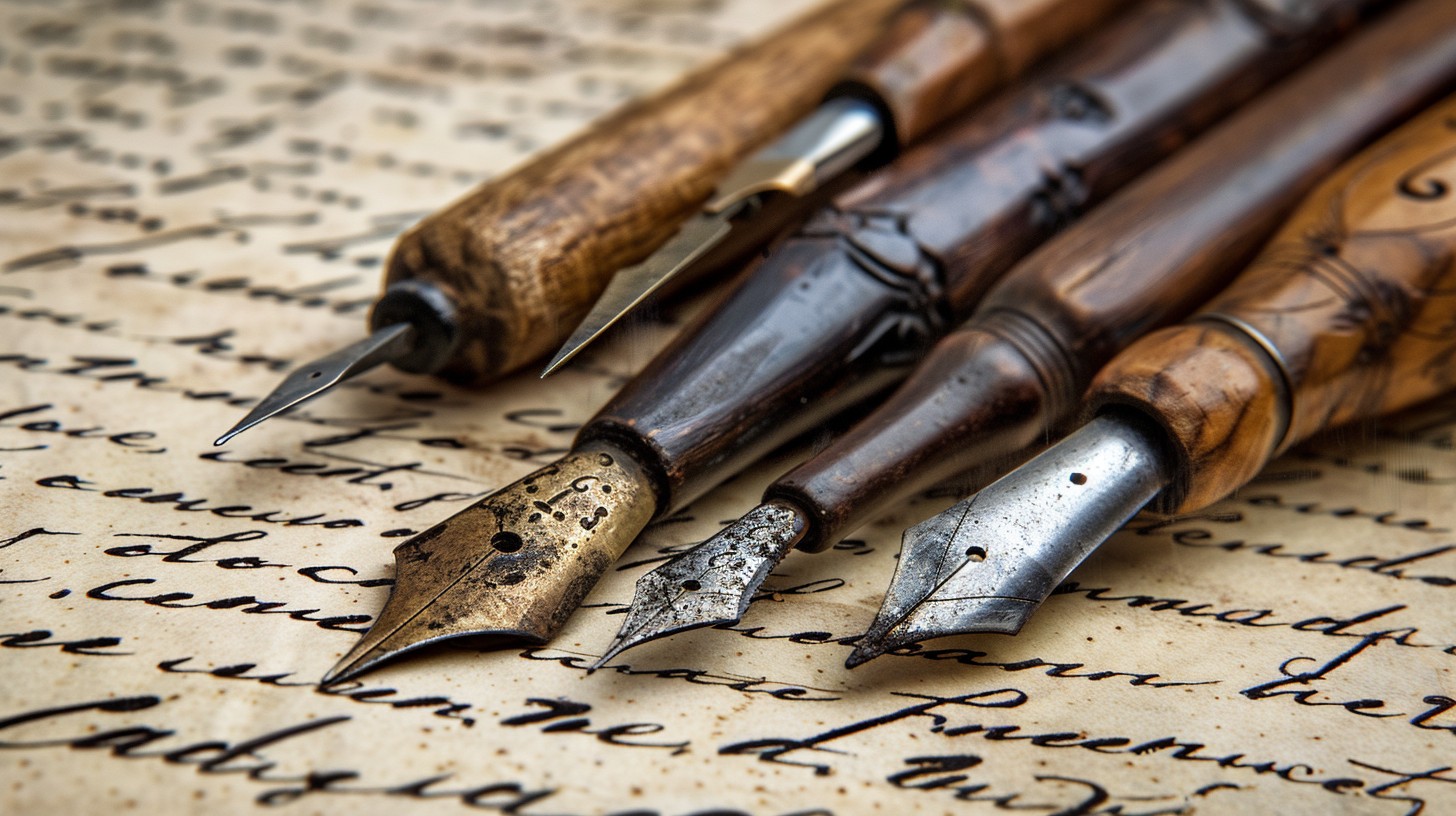
In 1822, an inventor John Mitchell, invented and began mass production of metal nibs (patented in 1803). These metal nibs, made from hard alloys of Iridium, Rhodium, and Osmium, replaced the quill pen by the 19th century. This was attributed to the durability of these nibs as compared to quills. Not long after, in1844, Lewis Waterman, an insurance broker, invented the first ever fountain pen which had an internal ink reservoir that fed ink to the nib through capilari action and with some help from good old gravity.
The more modern version of the ball point pen was invented in 1940 by Josef (Lazlo) and Georg Biro. In summer of 1943, the first commercial models were made, however the patent of Lazlo’s creation was bought over by the British Government. The design of the ball point pen was more rugged which was why sales sky rocketed during WWII as the military needed robust writing material to survive the battlefield environment. This invention was introduced to the US market in 1945 and was sold as the “the first pen to write underwater”. At the Gimbel’s department store in New York on 29th October 1945, some 10,000 units were sold at the launch.
In 1953, a French Baron, Bich (BIC, Co.) developed the industrial process of manufacturing ball point pens, lowering the cost dramatically, making the first inexpensive ball point pens. Tokyo Stationery Company, Japan (1960) invented the first felt tip pen and Papermate’s Flair was among the first to hit the US market and has led since. This set a stepping stone for highlighters. Early 1980s saw the birth of roller ball pens, unlike the thick ink used in the conventional ball point, roller ball pens employ a roller ball and liquid ink, producing a smoother line. In the 1990s onwards companies turned to using rubber to decrease the grip. A much newer patent is that of the ring pen, designed to write without gripping the pens with 3 fingers.

Thus is the evolution of man from scratching on the surface of moist clay to writing without gripping the pen.