

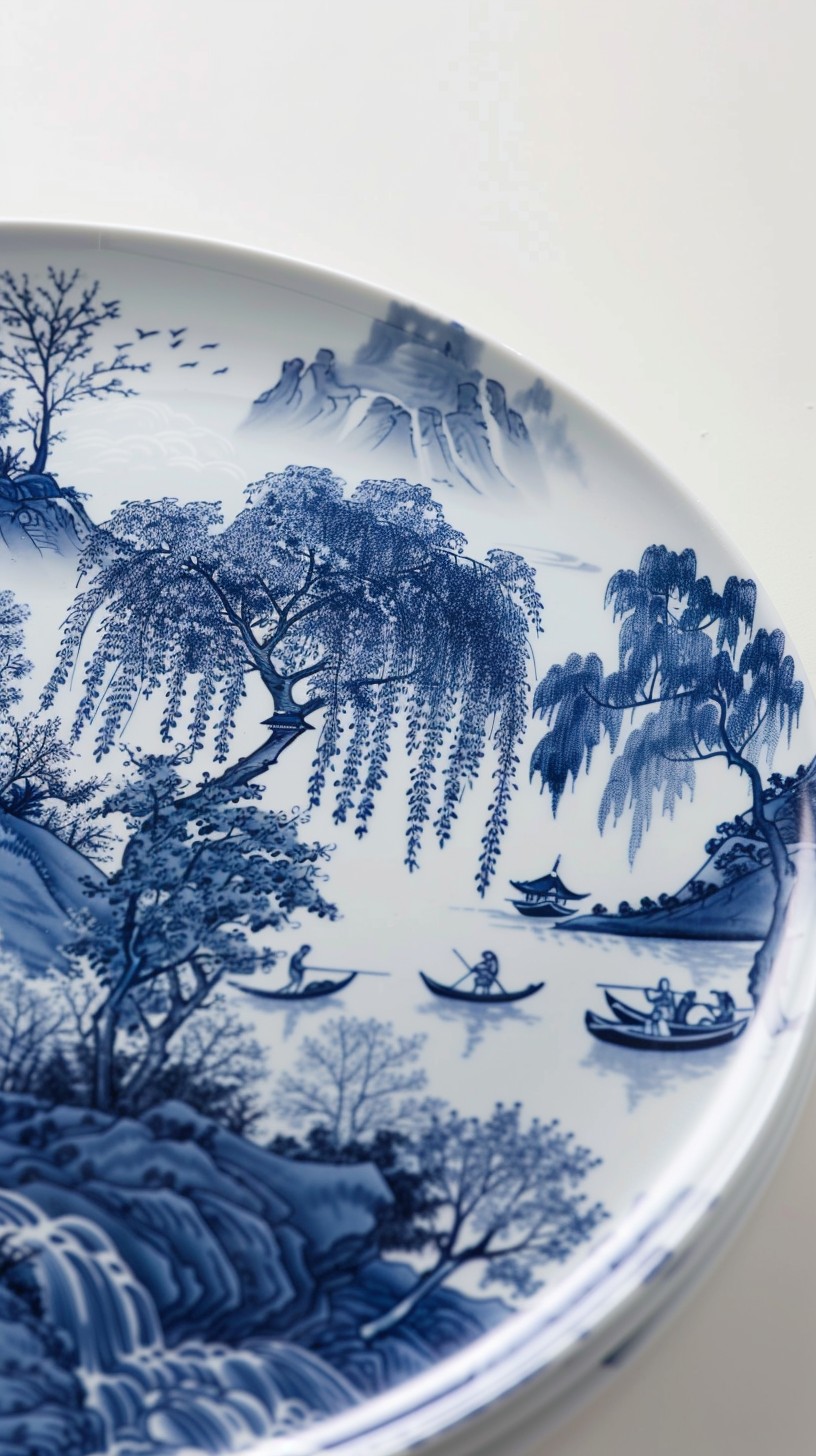
Porcelain dates back to roughly the 8th century where the whiteness and translucency had been achieved. Referred to as “china” rich history that spans over 1000 years. Renowned for its beauty, craftsmanship, and significant influence on global ceramics. Its whiteness and translucency that we see today was achieved around the 8th century. These “china” were exported across the globe making them highly prized.
Beginning with the word ‘ci’ meaning either porcelain or stoneware, it is the skillful transformation of ordinary clay into beautiful objects that captivated the many. 3 pivotal achievements in the Ming and Qing Dynasty were the blue and white porcelain, celadon glazed, and falangcai. Chinese ceramics by far are the most advanced in the world made especially for the imperial court, export, and even for the domestic market.
Ceramics are fired in oxidising (increasing the amount of oxygen) or reduction (reducing the amount of oxygen) during the process. Oxidising is famous in the Northern part of China creating glazes with warm, ivory covered glazes of porcelains whereas reduction is a process used in the Southern part of China creating a more cool, bluish tinge of porcelain.
Early forms of these items began with the proto-porcelain during the Shang & Zhou Dynasties (1600-256 BCE), these pieces were typically grey and unglazed but nevertheless set the foundation for later advancements. The Han Dynasty (206 BCE-220 CE) saw the development of glazed ceramics and introduced green-glazed wares known as ‘Yue ware’ which eventually became popular and even laid the groundwork for future porcelain development. The Tang Dynasty (618-907 CE) was well known for its ‘sancai’ (3 coloured) glazed ceramics used primarily in funerals. This was nevertheless an important mark to the productions of true porcelain (white and translucent) especially in the Northern region. The golden age of Chinese ceramics were considered in the Song Dynasty (960-1279 CE) where famous kilns (furnace houses) like the Ding, Ru, Jun, and Ge produced exquisite porcelain known for their simplicity, elegance and technical perfection. Also notably the celadon wares from the Longquan kilns that became highly prized.
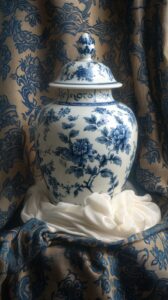
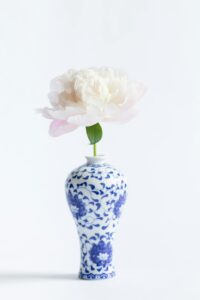
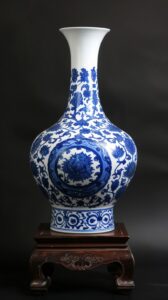
The more famous blue and white porcelain rose to fame in the Yuan Dynasty (1271-1368 CE), using cobalt blue underglaze on white porcelain bodies. This made the Jingdezhen kiln the centre of porcelain production and export across Asia and the Middle East. This refers to high-fired (1300’) white ceramics whose bodies are translucent in appearance and makes a high ringing sound when struck this is in contrast from stoneware which is tougher, non-translucent material fired at a lower temperature (between 1100’ to 1250’). Northern porcelain like that from the Ding kiln were made predominantly of clay rich in Kaolin (a fine soft white clay, resulting from the natural decomposition of other clays or feldspar) this is in contrast with Southern China where porcelain stone was the main material used in making porcelain. It is important to note that the imperial kilns, Jingdezhen, Jiangxi province, Southern China, kaolin was added to the porcelain stone as compared to the Fujian province where the porcelain stone alone was used, resulting in a more dense and compact “china” from the North (Fujian) and a more glassy, sugary version from the South.
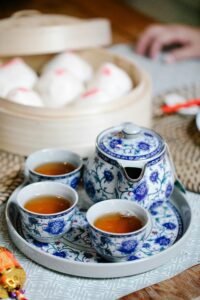
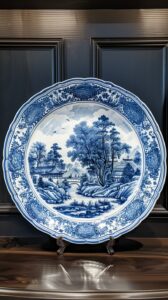
Porcelain production reached new heights during the Ming Dynasty (1368-1644 CE). Again the Jingdezhen kilns produced highly refined blue and white porcelain as well as polychrome enamelled wares. This was also the time that the ‘doucai’ (contrasting colours) and ‘wucai’ (five coloured) wares were introduced. Characterised with a range of colours, the Qing Dynasty (1644-1912 CE) continued the tradition of high-quality porcelain. Their range included famille verte (green family), famille rose (pink), and famille noire (black) which became popular. Another notable achievement of this time was the development of the translucent blue glaze called ‘claire-de-lune’.
Chinese porcelain had a profound impact on global ceramics, even influencing styles and techniques in Europe and the Middle East, this was especially noticed during the Ming and Qing Dynasties, where Chinese porcelain was introduced to the western world making it highly coveted. Today Jingdezhen remains a significant centre for porcelain production continuing a millennium long tradition that has long been associated with wealth and high social status within China and internationally. Their intricate designs and superior craftsmanship have influenced ceramics leading to adaptations globally. Innovations in glazing, kiln technology, and decorative techniques have significantly contributed to the advancement of ceramic arts. Modern Chinese artists and craftsmen blend traditional techniques with contemporary designs ensuring that Chinese porcelain not only remains as a statement to the skill and artistry of Chinese potters but also continues to evolve and inspire.